
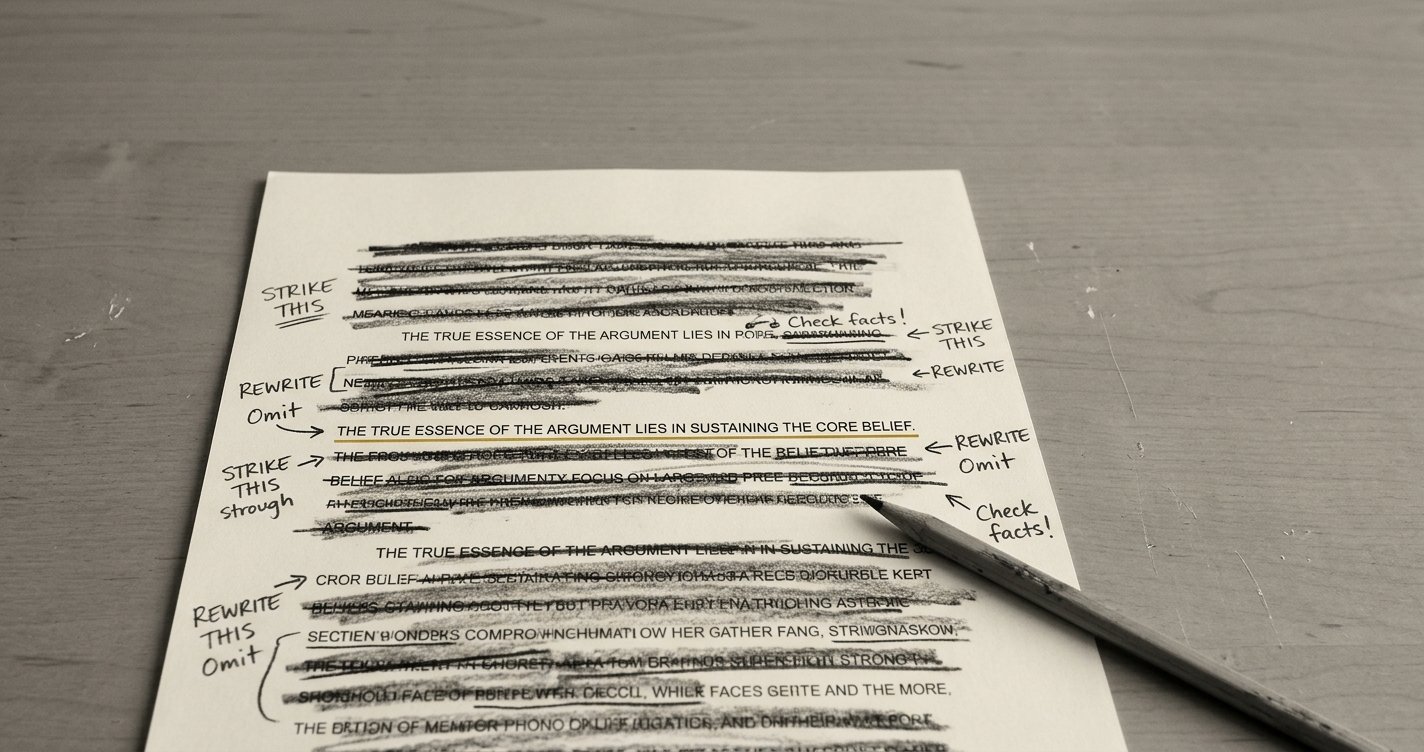
Because it has, and so has every version before it. Your approval process is built to stop you saying anything wrong, but nothing in it stops you saying nothing at all, so each reviewer removes one risky line and what survives is safe, accurate and unbelievable.
Here's how it usually goes. Your council's merging two library branches into one new hub. You interview the branch manager for the announcement, and without being prompted she says: "I'll miss this building. But the roof's leaked for six years and we can't keep pretending it's fine." It's the best thing anyone's said about the project.
Then it goes round. Legal takes out the roof, because six years of known leaks is a liability on the record. The CEO's office takes out "pretending", because it sounds like an admission. The local councillor wants "miss" gone, because the merger's already a sore point with residents. What goes out says the new hub "will deliver a modern, fit-for-purpose library experience for the whole community."
Within the hour, someone's posted a photo of the bucket under the leak in the comments. "Fit for purpose, is it?"
Nobody decided this
Every cut made sense. That's the trap. Legal reviews for liability, because that's their job. The executive reviews for reputation. The mayor's office reviews for politics. You review for key messages. Each of them is looking for the sentence that could go wrong, and each of them finds one.
What nobody's looking for is whether anyone will believe it. It isn't on anyone's checklist, so it isn't anyone's job. We call the result the sanitisation cycle. Real material goes in, every round takes out the part that's slightly uncomfortable, and the version that comes out is fine. Approved in thirty seconds. Ignored in three.
It isn't only councils. A super fund writes to members after a bad year, and "we got the timing wrong" becomes "we remain confident in our long-term strategy." A not-for-profit tells its funders a program's being scaled back, and "we couldn't recruit enough staff" becomes "we're refocusing to maximise impact." Same process, same result.
The line you cut was the one doing the work
The line that gets cut is almost always the one people already knew.
The residents knew about the roof. Members knew their balance fell. Funders knew the program was short of staff. When you leave out what your audience already knows, it doesn't go away. You've just shown them you won't say it, and now they're wondering what else you won't say.
That hard line was never the risk. It was the proof. It's the sentence that tells people you're seeing what they're seeing, and it's what makes them willing to believe the rest, including the good news. Take it out and the good news reads like spin, because there's nothing true beside it to vouch for it.
In a one-off campaign you might get away with that. In a continuing situation you won't. The people reading will still be your ratepayers, your members or your funders next year, and every sanitised piece makes the next one easier to discount, even when the next one's entirely true.
What you're about to try
You'll ask for a warmer rewrite. Same content, friendlier adjectives. The problem was never the tone. The true part came out, and no adjective puts it back.
You'll fight legal line by line. You'll mostly lose, and you should. They're holding real risk and you're arguing about feel. A liability beats a hunch every time.
You'll find a more relatable spokesperson. But a frontline worker reading approved lines doesn't sound like a frontline worker. They sound like someone who's been handed a script, because they have.
Or you'll skip review on the small stuff and hope. That works until it doesn't, and then the process tightens for everyone.
Agree what's true before anyone writes a word
The fix isn't less review. It's moving the hard conversation to the front, and changing what review is for.
Before anyone's interviewed or a draft exists, get the people who'll review it in one room: legal, the executive, whoever speaks for the politics. Ask one question. What's true about this situation that our audience already knows? Write the answers down. Then agree which of them you'll say plainly. The leaking roof is in. The staffing shortfall is in. That's a decision, made once, by the people with the authority to make it, instead of being reversed one tracked change at a time.
Then review checks the work against that agreement. Legal's questions become: is it accurate, is it fair, and is it safe for the person saying it? That's a far better use of a lawyer than judging tone. What review stops asking is whether anyone could read it badly. Someone always could, and that question is what empties everything out.
Documentary instinct
This is the habit a good documentary director brings to any situation, and it's the one most approval processes are missing. We call it documentary instinct. Documentary instinct is the discipline of putting truth first and beauty second: working out what's actually true before anything's made, then protecting it all the way to the version people see.
It's also why real people speaking for themselves hold up where polished messaging doesn't. When the branch manager says the roof leaks, in her own words, it's still the council saying it. But it lands as a person telling you what she sees every day, not an institution conceding a point, and the audience can hear the difference. Legal can check it's accurate and that she agreed to how she's shown. What nobody can do is rewrite her into a media release without everyone noticing, and that limit is exactly what makes her believable. It's not braver. It works better, because it's the one thing in the whole announcement nobody has to take on trust.
Where to start
Find the last thing you published on something contested. Then find the first draft, or the raw interview. Put them side by side and list what came out.
If what came out is mostly things your audience already knew, you've found your problem, and it isn't your writing. Before the next one, get your reviewers together before anything's drafted and agree the one hard thing that stays in. If you'd like help running that conversation, it's the first thing we do in a Narrative Brief.
Questions people ask next
How do we stop legal watering down our communications?
Stop asking them to approve tone and start asking them to approve facts. Before anything's drafted, agree with legal and the executive which hard truths you'll say plainly. Then legal reviews for accuracy, fairness and the safety of the person speaking, which is their real job. Most watering down happens because nobody agreed the hard part up front, so every reviewer treats it as optional.
Isn't it risky to admit problems publicly?
Less risky than leaving out what people already know. If your audience can see the problem, saying nothing about it doesn't protect you. It tells them you won't be straight with them, and they'll discount everything else you say. The risk worth managing is accuracy: say the hard thing correctly and fairly, and check it with legal before it goes out.
What should a legal review of communications actually check?
Whether it's accurate, whether it's fair to anyone named or affected, whether it breaches privacy or another legal obligation, and whether the people featured agreed to how they're shown. Those are real risks. Whether a line could be read unkindly isn't a legal question, and treating it as one is how communications end up saying nothing at all.
Why do real people speaking unscripted get through approval better than written statements?
Because you're approving something different. A written statement is the organisation making claims, so every claim gets tested for risk. Unscripted footage is a person saying what they've seen, in their own words. Reviewers can check it's accurate and that the person consented, but rewriting it would be obvious to everyone. That limit is exactly why audiences believe it more.